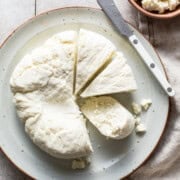
Queso Fresco Recipe
Learn how to make this homemade queso fresco recipe at home! Just 3 simple ingredients create this fresh, flavorful Mexican cheese.
Servings: 10 servings
Ingredients
- 1 gallon whole milk
- ⅔ cup distilled white vinegar
- 1 tablespoon kosher salt
Instructions
- Add the milk to a large pot or Dutch oven and heat over medium-low until the milk reaches 170℉, stirring frequently and reading the temperature with an instant-read thermometer. This should take about 1 hour.
- Take off the heat and pour in the vinegar. Gently stir until the milk starts to curdle.
- Leave the pot uncovered for 30 minutes and allow the curds to form and fully separate.
- Layer a colander or strainer with a cheesecloth and set it over a large bowl. Transfer the curds to the prepared colander with a slotted spoon or spider strainer.
- Cover the exposed curds with plastic wrap to keep in the moisture and allow it to drain for 20 minutes.
- Gently stir in the salt until combined.
- Press the cheese by gathering the curds into a ball in the middle of the cloth and pressing them into a hockey puck shape. Tie the cloth closed around the cheese. Place the bound cheese back in the colander or strainer and place a heavy can or pan on top. Let sit for about 1 ½ hours.
- Uncover the cheese and transfer it to an airtight container for storage in the refrigerator or use immediately.
Notes
- Storage: Homemade queso fresco can be stored in an airtight container in the refrigerator for up to 1 week.
- Vinegar: Queso fresco is a fairly simple and straightforward recipe. Some variations of recipes include using lemon juice instead of vinegar, but I found that it gave the queso fresco a much softer consistency, similar to ricotta. If that is your preference, you can use ¾ cup of fresh lemon juice (about 5-6 lemons) instead.
- For a more crumbly texture, gather and tie the cheesecloth over your faucet while it drips instead of pressing it.
- Salt can be added to taste. You can adjust it as needed when mixing it with the cheese curds.
Nutrition
Serving: 1serving | Calories: 230kcal | Carbohydrates: 18g | Protein: 12g | Fat: 12g | Saturated Fat: 7g | Polyunsaturated Fat: 0.4g | Monounsaturated Fat: 3g | Cholesterol: 45mg | Sodium: 842mg | Potassium: 568mg | Sugar: 18g | Vitamin A: 613IU | Calcium: 467mg | Iron: 0.01mg